Custom printed stretch film is hand or machine film printed with your own logo, wording or handling symbols, so every pallet leaves the dock carrying your brand. Unlike a sticker, the print is repeated on the film itself, which means the branding covers the whole load and cannot peel off in transit. For private-label sellers and exporters, printed stretch wrap turns a disposable material into a marketing surface that is already being paid for.
This guide explains how printing on stretch film works, what artwork you need to supply, and the decisions that affect cost, minimum order and lead time. The print runs described here are produced at ZT Packaging in Dongguan on the same cast lines as our clear and coloured film.
Contents
- 1. What Is Custom Printed Stretch Film?
- 2. How Printing on Stretch Film Works
- 3. Artwork and Print Specifications
- 4. Colours, Coverage and Repeat Length
- 5. Private Label vs Generic Film
- 6. Where Printed Film Pays Off
- 7. MOQ, Lead Time and Ordering
1. What Is Custom Printed Stretch Film?
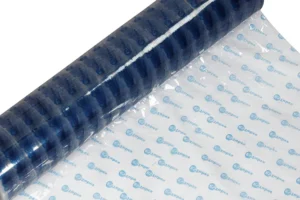
Custom printed stretch film is standard LLDPE stretch film with your artwork printed onto it in one to three colours. The film is printed before it is slit and rewound, so the design repeats evenly down the whole roll and appears on every layer of the wrap. A logo, a company name, a website or a simple warning such as “Do not stack” can be carried on the film, and the wrapped pallet then works as branded packaging without any extra material.
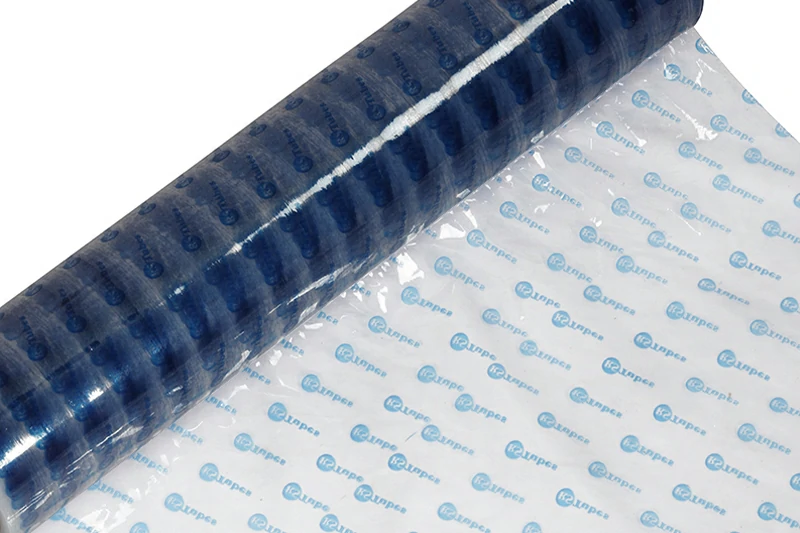
It is available as both hand film and machine film, in the widths and micron bands described in our guide on hand stretch film thickness. The print adds a process step, not a change of material, so the stretch, cling and puncture behaviour stay the same as the unprinted version.
2. How Printing on Stretch Film Works
Stretch film is printed by flexographic printing, the same method used for many packaging films. The film passes through a series of print rollers, one per colour, each carrying ink from a plate that matches your artwork. The printed film is then dried, slit to width and rewound into finished rolls.
The important consequence is that every colour needs its own plate, so a one-colour logo costs less to set up than a four-colour design, and the number of colours is the main driver of print cost. Registration, or how well the colours line up, is controlled on the press, and it is why artwork with fine detail and tight colour overlap needs a sample run before full production. The overall film behaviour is unchanged, as covered in our pillar guide on hand stretch film.
Printed rolls handle the same as plain rolls on a holder, so any dispenser that fits the standard core will take them; the options are compared in our guide to choosing a stretch film dispenser.
3. Artwork and Print Specifications
Good artwork is the difference between a clean brand mark and a smudged repeat. For printed stretch film, supply the following:
- Vector artwork — AI, EPS, PDF or SVG. Raster files blur where the film stretches.
- Colour references — Pantone numbers or a physical sample, so the ink is matched before a print run.
- Repeat and size — the printed repeat length and the film width it must fit.
- Mirror check — confirm whether the design should read correctly on the outside of the roll.
Two practical notes. Fine text under about 5 mm becomes hard to read once the film stretches, so keep wording large and simple. And heavy ink coverage can slightly reduce the film’s stretch performance, so a light repeat usually performs better than a full-colour block. These are the same trade-offs that apply to any printed packaging, and they are handled as part of custom projects in our custom stretch film solutions.
4. Colours, Coverage and Repeat Length
Printed film is specified by three numbers that together set the look and the cost:
| Specification | What it controls | Typical range |
|---|---|---|
| Number of colours | Print cost and design complexity | 1–3 colours |
| Repeat length | How often the logo appears down the roll | 250–1000 mm |
| Coverage | Ink area per repeat and film performance | Light logo to full band |
| Film width | How much of the design fits across the roll | 100–500 mm |
A short repeat puts the logo on the load more often and reads stronger when wrapped, but it also uses more ink. A long repeat is cheaper and looks calmer. Width decides whether the design sits as a single band or must be tiled across the roll, and the widths we can print are listed on our printed stretch film product page.
5. Private Label vs Generic Film
For distributors and private-label sellers, printed film is a way to sell under your own name without owning a factory. You specify the film, choose the print, and the roll arrives carrying your brand. This is OEM printed stretch film in its simplest form: the product looks and behaves like your own line because the visible surface is yours.
The alternative is generic clear film with a separate label, which is cheaper per roll but puts the brand on a sticker instead of the wrap. Where a load is handled repeatedly by the same customers, the printed version tends to justify the extra cost, and the colour options it can build on are set out in our guide to black and colored stretch film uses.
6. Where Printed Film Pays Off
Printed film is not for every load; it earns its cost where the wrap is seen by a decision-maker. Four situations stand out:
- Exports and distributor deliveries — the brand travels with the goods to customers you never meet.
- Trade shows and demos — a wrapped pallet is often the first thing a visitor sees.
- Retail and e-commerce supply — branded film reinforces the brand at the point of unpacking, a workflow described in our guide to stretch film for e-commerce and retail.
- Handling instructions — “This side up” or a batch code printed on the film is read without a label.
Where a full pallet is an overkill, the same branding logic is available on narrow rolls, as explained in our article on handy and mini stretch wrap.
Whether printed or plain, the film still has to be applied well to hold the load, and the manual method is set out in our guide on how to wrap a pallet by hand.
7. MOQ, Lead Time and Ordering
Printed film carries a higher minimum order than plain film, because a print run needs plates and a production slot. MOQ is set per colour and per width rather than per pallet, so the cheapest way to test printed film is to standardise on one width and one colour for the first order. Lead time runs longer than plain film, since printing, drying and rewinding all add a step.
Once a print is set up, repeat orders are faster and cheaper, which is why most buyers treat the first printed order as a setup investment. The way unit price moves with volume and terms is set out in our guide to hand stretch film wholesale.
Get a Free Quote from ZT Packaging
Send your logo and colour reference and tell us the pallet size and daily volume, and our engineers will suggest a repeat length, width and thickness for your load. We have printed stretch film in Dongguan since 2001 and can match a brand colour before the print run begins; the source behind that film is explained in our article on sourcing hand stretch film from a China manufacturer.
See the printed range alongside our parent hand stretch film line, or ask for a sample roll before you commit to a print run.
Email zt@dgztpacking.com or call +86-0769-87897718.
Frequently Asked Questions
How many colours can be printed on stretch film?
Up to three colours by flexographic printing. Each colour needs its own plate and ink station, so print cost rises with the number of colours and one or two colours is the usual choice for a logo.
What artwork file do you need for printed film?
Vector artwork in AI, EPS, PDF or SVG, plus a colour reference such as a Pantone number. Vector files stay sharp when the film stretches, while raster images blur.
Does printing weaken the film?
Only if ink coverage is very heavy. A normal logo repeat keeps the film’s stretch and cling. Very dense printed blocks can slightly reduce stretch performance, so a light repeat is recommended.
What is the minimum order for custom printed film?
MOQ depends on the number of colours and the film width, and it is higher than for plain film because of the print setup. Standardising on one width and one colour keeps the first order smaller.
Can printed film be used on a machine wrapper?
Yes. Printed film is made in both hand and machine formats, on the same cores, so it runs on powered wrappers exactly as plain film does; the choice between the two methods is compared in our article on hand stretch film vs machine stretch film.