Handy stretch film is a small roll of stretch wrap built around a handle, and mini stretch wrap is its shorter cousin for parcels and mixed loads. Both exist to solve one problem: a standard 500 mm pallet roll is too wide, too heavy and too wasteful for anything that is not a full pallet. At a packing bench, a courier drop or a trolley of loose boxes, a small roll is faster in the hand and leaves far less film on the floor.
This guide explains how handy stretch film differs from a full pallet roll, which width and micron suit each job, and the two buying mistakes that waste the most film at small packing stations. The specifications come from ZT Packaging’s own production in Dongguan, where mini rolls are cast and rewound on the same lines as our full pallet film.
Contents
- 1. What Is Handy Stretch Film?
- 2. Roll Sizes and Specifications
- 3. Handle Types: Integrated, Extended Core and Grips
- 4. Where Mini Stretch Wrap Is Used
- 5. Why Small Rolls Cut Film Waste
- 6. Choosing the Right Roll for Your Packing Station
- 7. Colour, Print and Private Label
- 8. Common Mistakes When Buying Mini Rolls
1. What Is Handy Stretch Film?
Handy stretch film is a narrow stretch wrap roll with a handle, so the operator can hold the roll and control tension with one hand. A mini stretch wrap roll works the same way but is smaller again, usually 100 mm to 150 mm wide, and is meant for single parcels, bundles and short stacks rather than a full pallet. Both are made from the same LLDPE (linear low-density polyethylene) resin as standard film, so they stretch and cling in the same way.
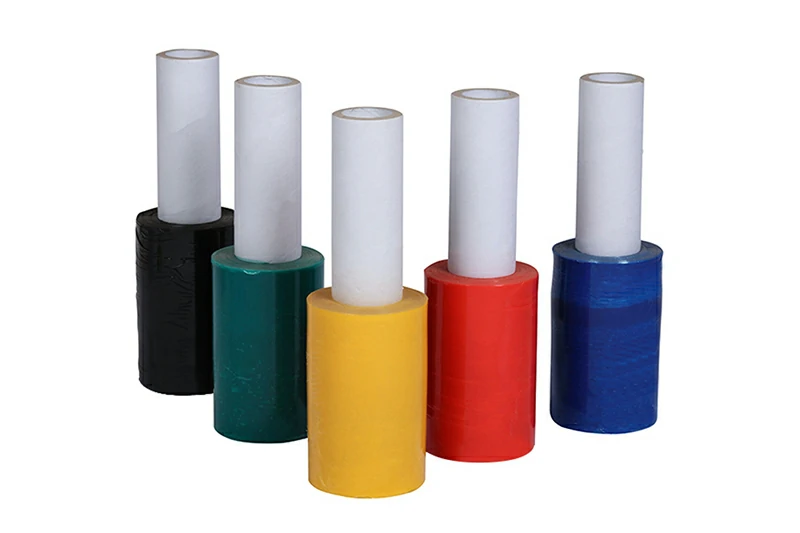
The difference from a standard roll is not the material but the format. A full pallet roll is 400 mm to 500 mm wide and weighs 2 kg to 5 kg; a handy roll is narrow enough to steer around a parcel with one wrist, which is why packing teams keep one at every bench. Compared with the manual pallet method described in our hand stretch film guide, these small rolls trade coverage per turn for control and speed on small loads.
2. Roll Sizes and Specifications
Mini and handy rolls are sold by width, micron and roll length. Width decides how much of the parcel you cover in one turn; micron decides how much abuse the film survives; length decides how often the operator changes rolls. The common combinations are shown below.
| Roll width | Typical micron | Roll length | Best for |
|---|---|---|---|
| 100 mm | 8–12 μm | 150–300 m | Small parcels, bundles, cable and wire |
| 120 mm | 10–15 μm | 150–300 m | Courier drop-offs and mixed small items |
| 150 mm | 12–17 μm | 200–400 m | Medium cartons and part pallets |
| 200 mm | 15–20 μm | 200–500 m | Half pallets and heavier single loads |
Micron and gauge are often used together on quotes, so it is worth fixing one unit with your supplier; the conversion is set out in our article on hand stretch film thickness. For mini rolls, the practical rule is to start thin. Because a small roll is usually wrapped around light items, an 8–12 micron film gives more metres per kilogram without sacrificing the hold.
3. Handle Types: Integrated, Extended Core and Grips
Three handle styles cover almost every mini roll, and the choice affects both comfort and cost:
- Extended core — the cardboard core extends past the film on both sides, so the operator grips the core itself. The cheapest option and fully recyclable, but harder on the hands over a long shift.
- Integrated plastic handle — a moulded grip is fixed into the core. Best comfort for daily packing stations and the style most teams standardise on.
- Detachable grip or mini dispenser — a separate handle or holder takes standard mini rolls and can be reused when the roll is finished. Lowest film cost over time, since you buy plain rolls.
If your team wraps hundreds of parcels a day, the integrated handle is usually the right starting point. A stretch wrap with handle — often described as handheld stretch wrap — is the format most packing lines standardise on, and the full range of holders and grips is listed on our handy stretch film product page.
4. Where Mini Stretch Wrap Is Used
Mini stretch wrap appears wherever loads are small but the count is high:
- E-commerce packing stations — securing multi-item orders and stopping small parts from shifting inside a carton before it is taped.
- Courier and parcel desks — bundling irregular items into one tidy package for a single label.
- Bundling loose parts — holding pipes, profiles and hardware together before they are palletised, as covered in our article on bundling film.
- Retail back rooms — wrapping roll cages and part pallets for a short trip to the shop floor.
- Warehouse top-off — adding a final band to a pallet that was wrapped moments earlier.
For retail and e-commerce teams in particular, the roll is a bench tool rather than a pallet tool, and the workflow it supports is described in our guide to stretch film for e-commerce and retail.
5. Why Small Rolls Cut Film Waste
Film waste at small packing stations rarely comes from the film being too thin. It comes from using the wrong width. A 500 mm roll wrapped around a 300 mm parcel leaves 200 mm of film doubled over itself on every turn, and that overlap is paid for and thrown away. A 120 mm or 150 mm mini roll covers the same parcel with far less excess, which is why the narrower roll usually lowers cost per parcel even though it costs more per kilogram.
The second saving is handling time. A 2–5 kg pallet roll has to be set down and picked up between items; a 0.5–1.5 kg mini roll stays in the hand. Across a full shift that difference is real, and it is one of the comparisons we work through in our article on hand stretch film vs machine stretch film.
6. Choosing the Right Roll for Your Packing Station
Match the roll to the load, not to the shelf. Work through three questions: what is the widest item the roll has to cover, how sharp are its edges, and how many wraps does one operator do per hour.
- Width: choose the narrowest roll that still covers the parcel in two or three turns. Narrower means less excess film.
- Micron: start at 12–15 μm for cartons, and step up to 17–20 μm only where edges are sharp or the load is heavy.
- Handle: integrated handle for high volume, extended core for occasional use, detachable grip for the lowest film cost.
- Length: longer rolls (300 m and up) reduce changeovers at busy benches.
If the same bench also wraps part pallets, it is worth keeping two widths on hand rather than forcing one roll to do both jobs, and the wrapping method itself is set out in our step-by-step guide on how to wrap a pallet by hand.
Where a bench also uses stand-mounted holders for larger rolls, our guide to choosing a stretch film dispenser compares the options.
7. Colour, Print and Private Label
Mini rolls can be supplied in colour or with a printed logo like their larger counterparts. A coloured mini roll helps a packing team spot which film belongs to which bench, and a printed roll puts a brand mark on every parcel without a sticker. The way colour is used for identification and security is explained in our guide to black and colored stretch film uses.
Printed mini rolls follow the same rules as pallet film: up to three colours by flexo, artwork supplied as vector, and a print repeat that fits the roll width. The artwork process and minimums are described in our article on custom printed hand stretch film.
8. Common Mistakes When Buying Mini Rolls
- Buying by price per kilogram only. A heavier roll is not automatically cheaper per parcel; width and excess overlap matter more.
- Choosing a roll that is too wide. Extra width is doubled over and thrown away on every small item.
- Ignoring core size. Handles and mini dispensers fit specific core diameters, so confirm the core before ordering in bulk.
- Mixing specifications per bench. Standardise one width and micron so operators are not relearning tension every time a roll changes.
Buying in volume is where the unit price is actually decided, and the terms that matter are broken down in our guide to hand stretch film wholesale.
Every mini roll here belongs to the same family as our main hand stretch film range, so pallet film and parcel rolls can be standardised from one supplier.
Get a Free Quote from ZT Packaging
Tell us your parcel sizes, daily volume and whether you prefer an integrated handle or a plain roll, and our packaging engineers will recommend a width and micron for your bench. ZT Packaging has manufactured stretch film in Dongguan since 2001, with a 40,000 m² factory, 20 cast lines and exports to more than 60 countries; the wider sourcing picture is set out in our article on sourcing hand stretch film from a China manufacturer.
Email zt@dgztpacking.com or call +86-0769-87897718.
Frequently Asked Questions
What is the difference between handy stretch film and mini stretch wrap?
Handy stretch film usually means a narrow roll with a moulded handle, often 100–200 mm wide. Mini stretch wrap is a smaller roll of the same idea, typically 100–150 mm wide, intended for parcels and bundles. In everyday use the two names overlap, and the deciding factor is the roll width, not the label.
Can I use mini stretch wrap on a pallet?
You can, but only for part pallets or a quick top-off band. A full pallet needs a 400–500 mm roll so each turn covers a useful band; a mini roll would take many more turns and more film. For full pallets, use standard hand film or a machine film.
What micron is best for a mini roll?
For most parcels, 12–15 micron holds well and gives a long roll. Drop to 8–12 micron for very light items and cable, and step up to 17–20 micron for sharp edges or heavier single loads.
Is a handle worth the extra cost?
At high volume, yes. A moulded handle protects the wrist and keeps tension even, which reduces film use and fatigue. At low volume, an extended core or a reusable detachable grip usually gives the lower total cost.
Can mini stretch wrap be printed with our logo?
Yes. Mini rolls can be printed in up to three colours, exactly like pallet film, provided the artwork is supplied as vector and the print repeat fits the roll width.