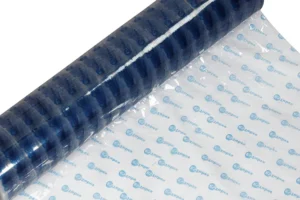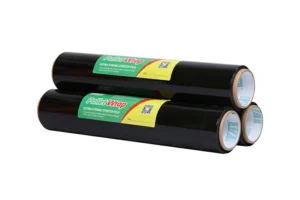
How to wrap a pallet by hand: anchor the film to the pallet base, make two or three turns around the bottom, spiral upward while overlapping each layer by 30–50%, add one or two reinforcing turns at the top, and press the loose tail under a lower layer to lock it. Done in that order, a manual wrap holds a load as safely as a machine wrap — the difference is speed, not safety.
This guide walks through how to wrap a pallet by hand, step by step, with the film quantity, tension and wrap patterns that keep pallets stable in transit. The numbers come from ZT Packaging’s own wrapping stations in Dongguan, where our operators wrap test loads on hand film produced on our cast lines every day.
Contents
- 1. What You Need Before You Start
- 2. How Much Film Does One Pallet Take?
- 3. Step 1: Inspect and Prepare the Load
- 4. Step 2: Anchor the Film at the Base
- 5. Step 3: Wrap the Base Turns
- 6. Step 4: Spiral Up with 30–50% Overlap
- 7. Step 5: Reinforce the Top and Lock the Tail
- 8. How Tight Is Tight Enough?
- 9. Spiral or Cross Wrap? Choosing a Pattern
- 10. Common Mistakes and How to Fix Them
- 11. How to Wrap Faster Without Losing Stability
- 12. Adjusting the Method for Different Loads
- 13. Film Supply and Customisation
1. What You Need Before You Start
The list is short: a roll of hand stretch film, a stable floor space, and gloves if your load has rough edges. A dispenser is optional but recommended, because it holds the roll on a turning axis and keeps tension steady while you walk — the difference shows up most clearly on the last quarter of a shift.
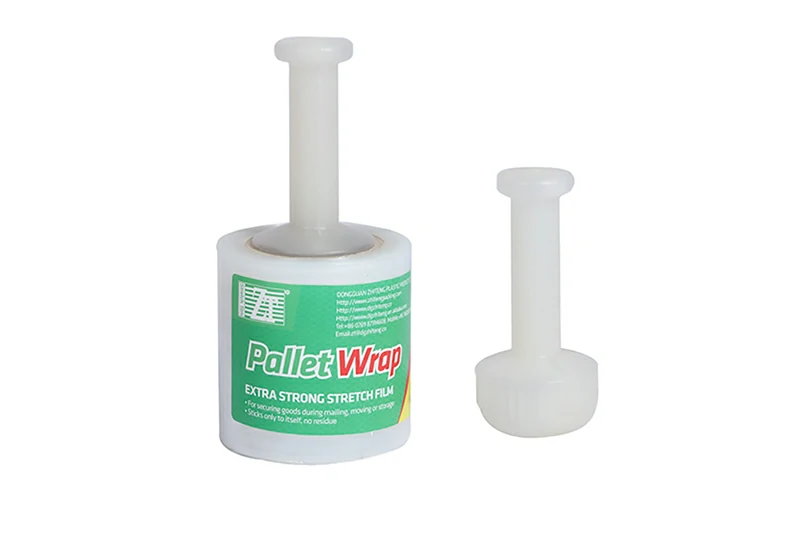
For pallet work, choose a 500 mm roll in the 17–23 micron range; a 400 mm roll is better for narrow or mixed loads. Whichever width you take, confirm the film’s thickness and elongation before you build a routine around it — the parameter ranges we hold on standard production are listed on the hand stretch film product page.
2. How Much Film Does One Pallet Take?
A standard 1,200 × 1,000 mm pallet wrapped in two to three layers of 20 micron film uses roughly 0.2–0.4 kg of film. The figure moves with load height, the number of layers and how much the operator stretches the film, but it is a useful planning number: one 2–5 kg hand roll is normally enough for 10 to 20 pallets.
Film economy is decided by thickness more than by technique. A thinner film yields more metres per kilogram, so the same roll covers more pallets, while a thicker film survives more edge abuse. Where that trade-off sits for your loads is worked through in our guide on hand stretch film thickness.
3. Step 1: Inspect and Prepare the Load
Before the film comes out, look at the load itself. Cartons should sit square on the pallet with overhang kept to a minimum, because film cannot compensate for a stack that leans. Heavy items belong at the bottom, and any loose top layer should be levelled by hand — a wrap holds a stable stack tightly and an unstable stack only loosely.
Then check the edges. Exposed metal corners, splintered wood and strapping ends will puncture film on the first revolution, so pad them with cardboard or move one band thicker; reinforced grades for exactly this job are described on our reinforced stretch film page.
4. Step 2: Anchor the Film at the Base
Stand at a corner of the pallet with the roll facing outward so the film unwinds as you walk. Pull about 30–40 cm of film free, twist it into a short rope, and tuck the tail under the first carton layer or through the pallet deck boards. This anchor is what stops the whole wrap from rotating during transport, so it is worth doing properly rather than quickly.
Keep the roll at roughly hip height and the film slightly angled, so the strip runs from low on the pallet to a little higher as you move. Angling the film by 10–20 degrees is what lets each turn sit above the previous one without forcing it.
5. Step 3: Wrap the Base Turns
Walk two to three complete turns around the bottom of the load, covering both the cartons and the top edge of the pallet itself. These base turns are the single most important part of the wrap: they tie the goods to the pallet, so if the load shifts, the pallet moves with it instead of sliding out from underneath.
Many operators rush this stage because it feels repetitive. Do not. Half the pallet failures we see in customer claims trace back to a load that was never locked to its pallet in the first place. The complete manual method, including how it compares with powered wrapping, is set out in our pillar guide to hand stretch film.
6. Step 4: Spiral Up with 30–50% Overlap
Now climb the load in a spiral. Each turn should overlap the one below by 30–50% of the film width — at 500 mm width that means advancing roughly 250–350 mm per revolution. A 50% overlap gives a double layer on every part of the load, which is the safer choice for tall or heavy pallets; 30% is enough for short, light, square stacks.
Keep your walking speed steady. Uneven pace is the most common reason a pallet wrapping job looks tight in one band and loose in the next, and the loose band is exactly where the film will billow and tear in transit.
7. Step 5: Reinforce the Top and Lock the Tail
At the top of the load, make one or two extra turns so the film folds over the top edge and holds the highest cartons down. Then finish: tear the film against the roll, press the loose end flat against the load, and tuck it under a lower layer so no tail is left free to catch on a forklift or a passing pallet.
On open-topped loads, folding the film over the top edge is what prevents the first carton from lifting when the load is handled. On very light pallets, a single rope turn across the top before the final layer adds holding force without much extra film.
8. How Tight Is Tight Enough?
Tension should be firm and even, not maximum. A good test is to press the wrapped corner with a thumb: the film should give slightly and spring back, not feel like a drum. If the film turns milky white or narrows to a thin band where you pulled hardest, it is over-stretched and has lost much of its elastic memory.
Even tension beats heavy tension, which is why a machine wrap can hold a load with thinner film than a manual operator using brute force. That comparison, including where each method makes sense, is worked through in our article on hand stretch film vs machine stretch film.
9. Spiral or Cross Wrap? Choosing a Pattern
Three patterns cover almost every manual job:
- Spiral wrap — the standard pattern described above. Best for square, stable stacks of cartons or bags.
- Cross wrap — the film is taken over the top from side to side as well as around the load. Adds restraint against sideways movement; useful for tall or narrow stacks.
- Rope wrap — the film is twisted into a cord and passed around a weak point, then covered by normal layers. Handy for bundling loose parts before the main wrap.
Whichever pattern you use, the goal is the same: keep every layer under tension and overlap, so the film’s elastic memory does the holding. Layout and pattern choices for powered lines are covered on our pallet wrapping solutions page.
10. Common Mistakes and How to Fix Them
- Wrapping only the goods, not the pallet. Add base turns so the load is tied to the deck.
- Pulling hard and fast. Over-stretching whitens the film and kills its memory; aim for even, moderate tension.
- Leaving the tail loose. Tuck the end under a lower layer so nothing can catch.
- Ignoring sharp edges. Pad the corners or step up one thickness band before the film punctures.
- Wrapping small items with a full 500 mm roll. A handled mini roll is faster and wastes less film on parcels and half pallets, as explained in our guide on handy and mini stretch wrap.
11. How to Wrap Faster Without Losing Stability
Speed comes from three places: a dispenser, a fixed routine, and rolls that suit the load. A dispenser lets the film unwind smoothly so the operator can walk at a normal pace instead of fighting the roll; the types available and how to pick one are compared in our guide on choosing a stretch film dispenser.
A routine matters just as much. Wrapping in the same direction, with the same overlap and the same finishing move, removes small decisions from the job and typically cuts a pallet’s wrapping time without weakening the wrap. The hardware that supports this — hand-held and extended-handle models for 400 mm and 500 mm rolls — is listed on our dispenser product page.
12. Adjusting the Method for Different Loads
The method stays the same; the emphasis changes. E-commerce and retail packing stations wrap many small, light loads a day, where speed and film economy matter more than brute holding force — those workflows are described in our article on stretch film for e-commerce and retail.
Where a load has to be identified at a glance, the wrap itself can carry the information. A colour scheme — one colour per customer, route or shift — speeds up sorting and reduces mis-shipments, and the practical uses are covered in our guide to black and colored stretch film uses.
13. Film Supply and Customisation
Once the routine is set, the remaining variable is the film itself. Weight, stretch behaviour and core size all change how the roll feels in the hand, so it is worth locking one specification and buying it consistently rather than switching between suppliers on price.
Where the wrapped pallet carries your brand — repeated logos or handling instructions printed on every layer — printing can be applied to standard hand film; the print widths and artwork requirements are set out in our article on custom printed hand stretch film.
Buying in volume is where per-pallet film cost is decided, and the terms that matter — MOQ, lead time and what moves unit price — are broken down in our guide on hand stretch film wholesale.
Source from the mill and the same supplier can also adjust thickness, width, colour and printing without a second vendor, as explained in our article on sourcing hand stretch film from a China manufacturer.
Get a Free Quote from ZT Packaging
Knowing how to wrap a pallet by hand is a skill that a good film makes easier. Tell us your pallet size, load weight and daily volume, and our packaging engineers will recommend the right width and thickness for your wrapping stations — with a specification and quote — within 24 hours. ZT Packaging has manufactured stretch film in Dongguan since 2001, with a 40,000 m² factory, 20 cast lines, an annual capacity above 60,000 tons and exports to more than 60 countries. Email zt@dgztpacking.com or call +86-0769-87897718.
Frequently Asked Questions
How many layers of stretch film should a pallet have?
Two to three layers is the usual standard for stable carton loads, with an extra layer over the top edge and around the base. Tall, heavy or irregular loads benefit from a fourth layer at the corners.
Should I wrap the pallet or just the products?
Always include the pallet. The base turns tie the load to the deck, which stops the stack from sliding when the pallet is lifted or braked. Wrapping only the cartons leaves the most common failure point unprotected.
Which direction should I wrap a pallet?
Walk around the load in a consistent direction with the film coming off the roll from the outside, so the strip stays flat against the pallet. Direction itself matters less than keeping the same overlap and tension on every turn.
Can I wrap a pallet by hand without a dispenser?
Yes. A bare roll works for occasional wrapping, but the operator has to control tension by hand, which tires the wrist and produces uneven wraps over a long shift. A dispenser pays for itself quickly once you wrap more than a few pallets a day.
How quickly can I learn how to wrap a pallet by hand?
Learning how to wrap a pallet by hand to a repeatable standard takes most operators a shift or two. After that, an experienced operator wraps a standard pallet in roughly one to two minutes, including the base turns and the finishing lock. Time rises with load height, awkward shapes and any reinforcing still needed.