Choosing between hand stretch film and machine stretch film comes down to one practical question: how many pallets do you wrap, and how steady is that volume? Both films are made from the same LLDPE (linear low-density polyethylene, a strong and transparent plastic resin), yet they are engineered for opposite working conditions — one for an operator on foot, the other for a powered wrapping machine.
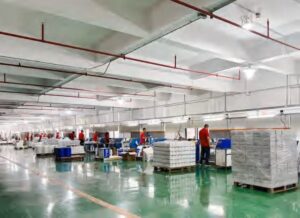
This comparison works through the specifications that actually decide the purchase: roll format, core size, thickness, stretch behaviour, film cost per pallet and load type. Every figure below comes from ZT Packaging’s own cast lines in Dongguan, China, where we have produced stretch film since 2001 on 20 in-house lines.
Contents
- 1. What Is the Difference Between Hand and Machine Stretch Film?
- 2. How the Two Films Are Applied
- 3. How the Two Films Are Built Differently
- 4. Cost per Pallet: Film, Equipment and Labour
- 5. Finding Your Break-Even Volume
- 6. When Hand Film Is the Only Practical Choice
- 7. When Machine Film Pays for Itself
- 8. Can You Use One Film on the Other’s Setup?
- 9. The Hybrid Setup Most Factories End Up With
- 10. Which Film Suits Which Industry?
- 11. A Five-Question Decision Checklist
- 12. Frequently Asked Questions
- 13. Get a Free Quote from ZT Packaging
1. What Is the Difference Between Hand and Machine Stretch Film?
The short answer: hand stretch film is wound into light rolls that a person can carry and tension by hand, while machine stretch film is supplied in heavy jumbo rolls that a wrapping machine pre-stretches and applies automatically. The resin is similar; the roll format, core diameter and stretch behaviour are not.
| Dimension | Hand Stretch Film | Machine Stretch Film |
|---|---|---|
| Applied by | Operator, by hand or with a dispenser | Pallet-wrapping machine |
| Typical thickness | 12–23 micron | 15–30 micron, high pre-stretch grades |
| Paper core | 50 mm inner diameter | 76 mm inner diameter |
| Roll weight | 2–5 kg | 10–20 kg and above |
| Roll length | Short — a few hundred metres | Long — 1,500–3,000 m jumbo rolls |
| Stretch handled | Operator tension, usually under 100% | Powered pre-stretch, 150–300% |
| Best volume | Low to medium and irregular loads | High, steady pallet lines |
If you are still assembling a manual wrapping station, our complete guide to hand stretch film covers roll widths, dispensers and load matching in a single place.
2. How the Two Films Are Applied
Manual wrapping depends on the operator. The person controls tension by pulling the film as they walk around the load, overlapping each layer by 30–50%. This makes hand film forgiving: the same roll works on a square pallet, a narrow bundle and a furniture item without any changeover. A dispenser improves consistency but is not essential to the method.
Machine wrapping removes the operator from the tension equation. The load is placed on a turntable or rotating ring, and a powered carriage pulls film from the roll at a set pre-stretch percentage before it touches the pallet. The result is identical wrap force on pallet one and pallet one thousand. The trade-off is flexibility: the load has to fit the machine, and odd shapes are usually rejected. Step-by-step technique for the manual method is set out in our guide on how to wrap a pallet by hand.
On the powered side, the available film grades — from standard 20 micron up to high pre-stretch formulations — are listed on the machine stretch film product page.
3. How the Two Films Are Built Differently
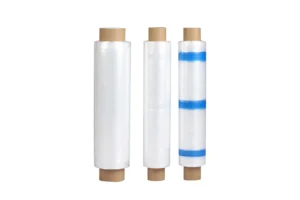
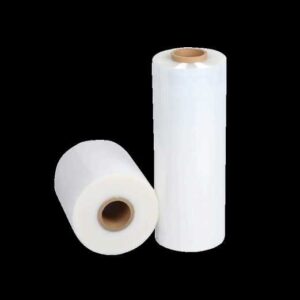
The two products come off the same cast line but are finished for different hands. Hand film is slit to 400 or 500 mm and wound onto a 50 mm core in short, light rolls; machine film is wound onto a 76 mm core in long, heavy rolls, and often supplied as jumbo rolls for high-throughput lines.
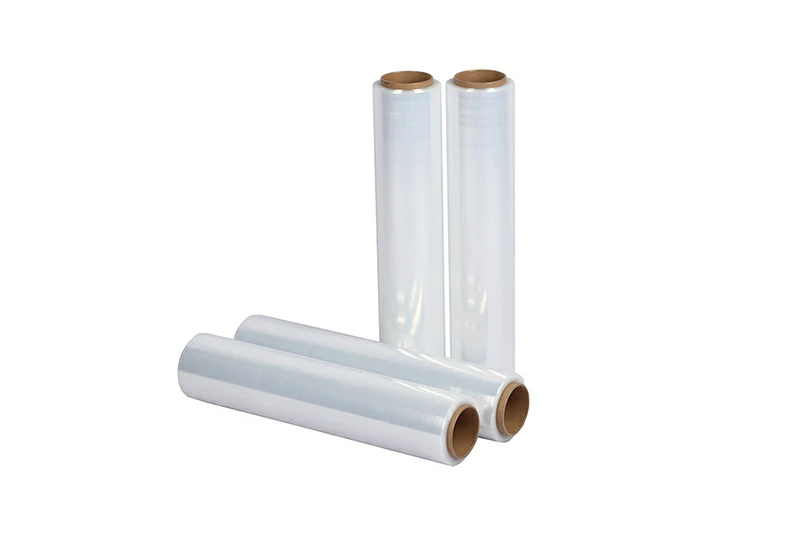
- Core size — 50 mm for hand film so the roll stays light enough to carry; 76 mm for machine film so the carriage can spin it at speed.
- Thickness — hand film runs 12–23 micron; machine film runs thicker because powered pre-stretch thins the film as it is applied.
- Meters per roll — a hand roll carries a few hundred metres, while a machine roll or jumbo roll can carry 1,500–3,000 m before a changeover.
- Stretch behaviour — hand film is formulated for easy manual elongation; machine film is formulated for high pre-stretch without breaking.
Two accessories follow from this roll format. Powered lines usually run our pre-stretch film grades, because the machine can pull them to a high stretch ratio without breaking.
High-volume warehouses, in turn, standardise on long machine rolls to cut changeover time; the roll lengths and core options we supply are listed on our jumbo roll page.
If thickness itself is the open question, the micron and gauge bands for hand film are explained in our guide on hand stretch film thickness.
4. Cost per Pallet: Film, Equipment and Labour
Hand film usually costs more per kilogram than machine film, because thinner film and a 50 mm core add processing steps. That headline price, however, is the least useful number in the comparison.
The honest measure is film cost per wrapped pallet rather than per kilogram. Because a machine pre-stretches film by 150–300%, one metre of machine film covers two to four times the surface of an unstretched metre of hand film. A wrapping machine can therefore cut film consumption per pallet by roughly 30–50%, while also reducing the labour minutes tied to each load.
Against that saving sits the machine itself: a turntable wrapper, its power, maintenance and floor space. For a low-volume operation the equipment never earns back its cost, and hand film remains the cheaper option from day one. A wholesale buyer comparing quotes should look at delivered cost per pallet, not price per roll — the factors that move that number are broken down in our guide on hand stretch film wholesale.
5. Finding Your Break-Even Volume
As a working rule of thumb, a powered wrapper starts to pay for itself somewhere between 15 and 30 pallets per day, depending on film price, labour rate and machine cost. Below that band, the equipment cost is spread across too few pallets to beat manual wrapping. Above it, film savings and freed labour dominate.
Four numbers decide where your own line sits: pallets wrapped per day, film cost per kilogram, hourly labour cost and the purchase price of the machine. Multiply daily pallets by the film saved per pallet, add the labour hours recovered, and compare the annual total against the machine’s amortised cost. If the difference is small, staying manual keeps your capital free for other work.
Many sites also get part of the benefit without a wrapper, simply by adding a good tension-controlled dispenser at the packing bench; the three common types are compared in our guide on how to choose a stretch film dispenser.
6. When Hand Film Is the Only Practical Choice
Some loads never meet a wrapper. Field packing, site deliveries, trade-show returns and mixed pallet builds all happen away from a fixed line, and in each case hand film is the only film that can travel to the job.
Hand film also wins wherever loads are unpredictable. A wrapper gives its best result on a stable, square, evenly stacked pallet; a worker with a roll can wrap a leaking drum, a loose bundle of extrusions or a pallet of assorted cartons without stopping to re-programme anything. For teams wrapping hundreds of parcels rather than pallets, a handled mini roll removes even the dispenser — the options are described in our guide on handy and mini stretch wrap.
7. When Machine Film Pays for Itself
Machine film wins on three conditions, and it needs all three. First, volume: enough pallets a day to keep the wrapper busy. Second, consistency: loads of similar size and shape that fit the machine’s envelope. Third, continuity: a steady flow of outbound pallets over months, not a seasonal spike.
When those conditions hold, the benefits compound. Wrap force becomes uniform, which reduces transit damage and customer claims; film use per pallet falls; and the operator who used to walk each load is redeployed to packing or picking. The layout and film choices behind a powered line are covered on our pallet wrapping solutions page.
8. Can You Use One Film on the Other’s Setup?
Hand film can physically be loaded onto a wrapping machine, but it is a poor match: the 50 mm core and low pre-stretch formulation mean the carriage will either slip or snap the film, and the short roll length forces constant changeovers. Machine film on a manual roll is the opposite problem — a 10–20 kg roll cannot be tensioned by hand for a full shift, and operators quickly lose wrap consistency to fatigue.
The practical rule is to match roll format to the application and treat the two as separate specifications. Full parameter ranges for the manual side, including width, core and thickness tolerances held to ±5%, are listed on the hand stretch film product page.
9. The Hybrid Setup Most Factories End Up With
In practice, most growing operations run both. A turntable wrapper handles the regular, high-volume pallets, while a bench with hand film absorbs the exceptions: part loads, re-wraps of damaged sections, and the odd-shaped items the machine cannot take. This split keeps throughput high without forcing every load through one method.
Stocking both films also makes better use of the same supplier and shipment, which matters when you are loading a container. The dispenser bridges the two worlds by giving manual wrapping a consistent tension similar to a machine, and our dispenser product page lists the models sized for our 400 mm and 500 mm rolls.
10. Which Film Suits Which Industry?
Industry shapes the answer as much as volume does. E-commerce and retail fulfilment centres wrap far more small parcels than pallets, so hand and mini rolls dominate their packing benches, and the workflows are described in our article on stretch film for e-commerce and retail.
Retail chains that ship to stores often want the wrapped pallet to do branding work as well. That pushes them toward machine film in a house colour, and the trade-offs between concealing loads and signalling handling routes are covered in our guide to black and colored stretch film uses.
Manufacturers and exporters with steady pallet lines usually land on machine film, while distributors serving mixed customers stock both. Where a logo or handling instruction has to travel with the goods, custom printing can be applied to either format — see our article on custom printed hand stretch film for print options and artwork requirements.
11. A Five-Question Decision Checklist
Answer these five questions in order and the choice usually makes itself:
- How many pallets do you wrap on a normal day — under 15, or steadily more?
- How similar are those loads — one standard pallet, or a mix of sizes and shapes?
- Where does wrapping happen — one fixed bay, or several points across the site?
- What does a damaged pallet cost you in claims and re-work?
- Is capital available for a wrapper, or would a dispenser and better hand film solve most of the problem?
Whichever route you take, buying directly from the mill keeps both formats — and the transition between them — under one specification and one quality system. The reasons buyers consolidate on a factory source are set out in our article on sourcing hand stretch film from a China manufacturer.
12. Frequently Asked Questions
Can machine stretch film be used by hand?
Technically yes, but it is impractical. A machine roll weighs 10–20 kg or more and sits on a 76 mm core, so it cannot be carried and tensioned comfortably for a full shift. Hand film exists precisely to solve that problem.
Is hand stretch film more expensive than machine stretch film?
Per kilogram, usually yes. Per wrapped pallet, not necessarily. Machine film is pre-stretched by 150–300% on the wrapper, so it covers more load surface per metre, but that saving only exists if you own and run the machine.
How many pallets a day justify buying a wrapping machine?
As a rough guide, 15–30 pallets a day of similar loads is the band where a turntable wrapper typically starts to pay back. Below that, hand film plus a dispenser is usually the lower-cost route.
Do hand and machine stretch film use the same core size?
No. Hand film is standard on a 50 mm core and machine film on a 76 mm core. The larger core fits the machine carriage and lets the roll spin at speed without wobbling.
Which film gives better load stability?
Applied correctly, both hold a load securely. Machine film gives more repeatable tension because the pre-stretch is set by the machine, while hand film depends on operator technique. For irregular or one-off loads, a well-tensioned manual wrap is often the more reliable option.
13. Get a Free Quote from ZT Packaging
The right choice is a volume question, and we can answer it from your own numbers. Send us your daily pallet count, load type and pallet size, and our packaging engineers will recommend hand film, machine film or a combined setup — with a specification and quote — within 24 hours. ZT Packaging has manufactured stretch film in Dongguan since 2001, with a 40,000 m² factory, 20 cast lines, an annual capacity above 60,000 tons and exports to more than 60 countries. Email zt@dgztpacking.com or call +86-0769-87897718.